
Sustainable Travel – November 2025
November 24th is World Sustainable Travel Day and sustainable travel is an excellent opportunity for employers and employees to improve their understanding of sustainability and how easy it is to implement a sustainable transport policy. A sustainable transport policy can benefit the business by reducing its carbon footprint and can also benefit employees by improving their health and their local environment.
So, what is sustainable travel?
Sustainable Travel refers to the idea that it is possible and necessary to travel well by reducing or removing reliance on vehicles that burn fossil fuels and create greenhouse gases such as CO2. Since its inception as a philosophy in the 1970’s sustainable travel has grown to incorporate many areas including:
- Sustainable Transport Networks
- Sustainable Freight
- Sustainable Tourism
- Regeneration Tourism
- Responsible Travel
Although your business may cover more of these, here we will focus on sustainable transport, its benefits, impacts, and how with a few changes you can create a sustainable transport policy that can be adopted and used towards completion of the Good Health @Work Standard 6: Social Responsibility and Environmental Sustainability.
Follow this link if you would like to learn more about the Good Health at Work Standards.
What is sustainable transport?
Sustainable transport as defined by the UN ‘refers to mobility systems that seek to minimise greenhouse gas emissions and environments, while ensuring safety and affordability, improving energy and resource efficiency and providing equitable mobility for all.’ (1)
Importantly, sustainable transport does not refer to one single solution, and neither should you. When considering sustainable transport for your business you may immediately think of how you and your employees get to and from work. However, transport covers a vast array, including for instance:
- Importing/Exporting
- Deliveries
- Team or company meetings
- Field Sales
- Field Maintenance
- On site work such as plumbing etc
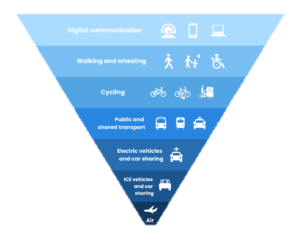
The sustainable travel hierarchy below is quick reference to help you understand where each mode of transport sits in terms of sustainability, with digital communication being the most sustainable and air transport being the least.
Why is sustainable transport important?
Currently 13.7% of all global greenhouse gas emissions are generated by the transport sector. These greenhouse gases contribute to global heating and accelerated man-made climate change, as well as causing air pollution which is estimated to contribute to 6.7million premature deaths a year.
In the UK alone 66% of commuters travel by car (3), this is largely a result of gaps in public transport, particularly noticeable in rural areas and for shift workers who keep unsociable hours. As well as the pollution caused by the cars themselves, they can also add pressure to employers to provide parking and employees (where required to pay for it), which adds an additional financial stress.
All of this can affect staff recruitment and retention. The COVID pandemic and the increase in remote working there has been an increase in employees choosing to leave jobs because of a bad or unnecessary commute as they have become increasingly able to find remote work which in itself improves workplace sustainability.
Implementing a sustainable transport policy can help your business play its part in reducing green house gas production whilst also providing other benefits such as improved physical and mental health and creating demand for better public infrastructure.
What should you include in your sustainable transport policy?
First things first, before creating your policy, take time to survey your employees and supply chain to understand their current choices. You may find some of your workforce are already travelling sustainably and you will get a better sense of why those choices are made how they can influence others. Indeed, you may also find that the delivery vehicles that bring your parcels are electric. Surveying and understanding your current situation allows you to write a policy that can have some worth rather than being a tick box exercise.
When writing your policy consider all the various types of transport that are used by your business, staff, suppliers etc. Break this down by category and consider what power you have to improve the sustainable transport for those categories.
For instance, you may be able to offer employees a bike to work scheme or provide good cycle storage, or create a carpool system where overall journeys are reduced due to car sharing. Alternatively, if you are a business with vehicles, you may wish to commit to renewing with electric vehicles rather than petrol or diesel. It is also important consider your supply chain, do you have any influence to select businesses who have themselves committed to a sustainable transport policy and introduced electric delivery or fleet vehicles. Consciously consider the choices that you have available to you and bring the idea of sustainability into your long term strategy.
Bring people along so that they are excited by the possibilities for themselves as well as the business, for example use employees that are keen to get involved by creating sustainability champions who can raise awareness of the policy, what’s available and what the benefits are.
What should a Sustainable Transport Policy look like?
A sustainable transport policy should take the format of other standard employee policies. This keeps it familiar whilst giving a good breakdown of roles, responsibilities and expectations.
As with all policies it is important to lay out:
Purpose: What you want it to achieve
Scope: How far you want your policy to go, who is included and to what extent
Promotion: What are you going to do to promote awareness of the policy and your expectations of the policy
Support: What support are you going to put in place to ensure that the policy is achievable
Long term planning: How will this policy influence your long-term strategy
Manager Responsibilities: What are your expectations for the managers to ensure the policy can be implemented effectively and fairly.
Employee Responsibilities: What are your expectations of your employees when they engage with this policy.
Confidentiality: Does this policy require a confidentiality clause and if so how will you apply it and to what parties.
Review and Continuous Improvement
Will this policy be reviewed annually, or sooner, if necessary, to ensure it reflects current best practices. How will you review this policy? Will it rely on feedback from employees and stakeholders? How will you implement this?
What Next?
Once you have created your policy, promote it widely across your organisation. Encourage your workforce to share their experiences of swapping to sustainable travel and use internal comms to celebrate these achievements.
To understand the material difference the policy has made, implement a recurring sustainable travel survey. Measuring your progress will not only help you understand the improvements you have already made but will shed light on any areas that could be improved.
Want to know more.
If you are interested in learning more about sustainable travel here are some resources you may find useful.
Sustainable travel – BBC Bitesize
Workplaces – Walk Wheel Cycle Trust
An introduction to the sustainable travel hierarchy – Energy Saving Trust
References:
2An introduction to the sustainable travel hierarchy – Energy Saving Trust